Support that meets you where you are.
Every office is different. Your resources, your hazards, your team size, your timeline — none of it is the same as the community down the road. Our services are built to be useful whether you're starting from scratch or trying to close specific gaps.
Products & Services
Find the level of support that fits your situation.
Every office is different. Some need a self-guided tool they can work through independently. Some need weekly accountability and office hours. Some need a mentorship partner embedded in their work for 90 days. We have all of it, and the pricing is designed to reflect the real financial constraints of small and under-resourced offices.
-
A complete, self-guided emergency management system.
For solo emergency managers, new coordinators, and small offices that need a proven framework to build capacity with confidence.
What You Get
Five-phase roadmap to build a resilient emergency management program in 90 days
Three proprietary frameworks, decision tools, and ready-to-use templates
A step-by-step system you can implement at your own pace
$297
Instant PDF Download
-
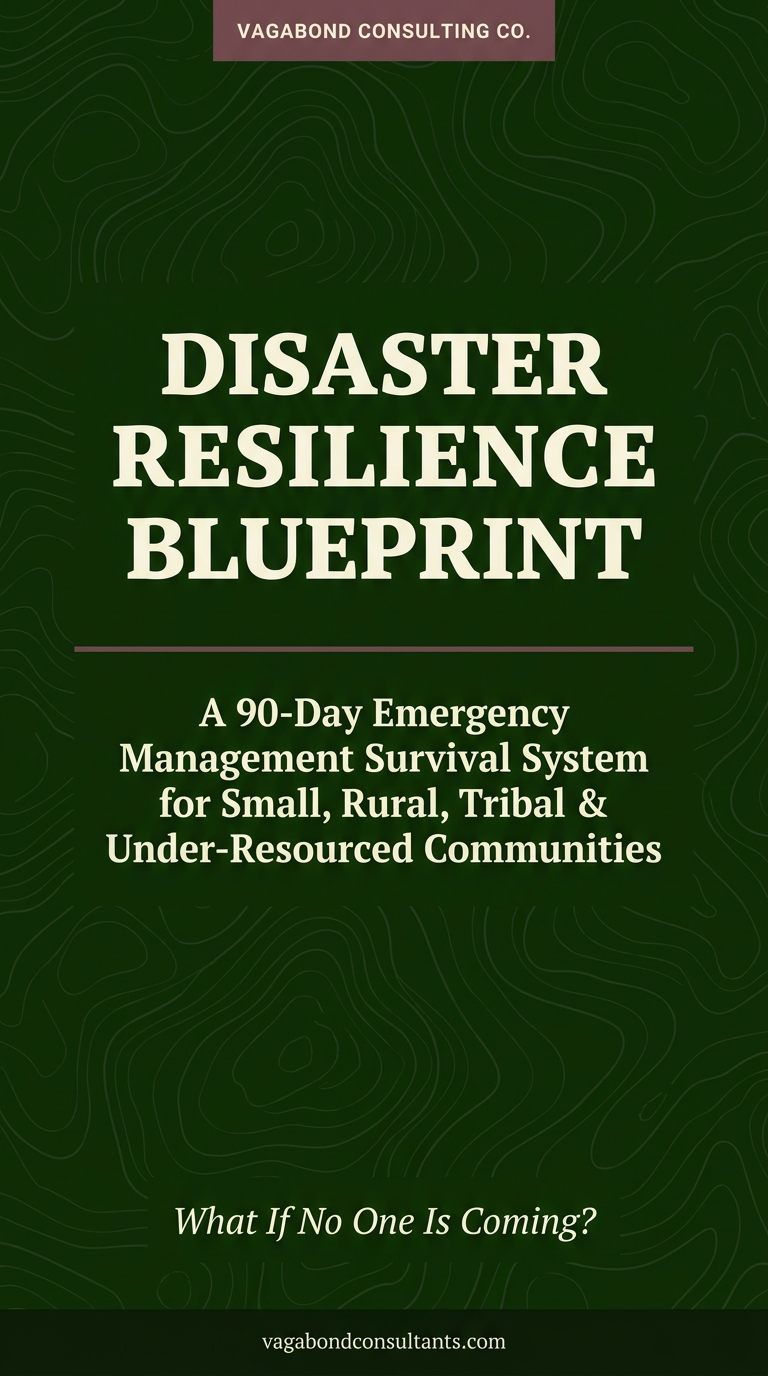
A comprehensive video training program that walks you through every phase of the DRB system.
For emergency managers and small offices that want expert instruction, practical examples, and a repeatable training resource for their entire team.
What You Get
Six in-depth training modules with downloadable slides and worksheets
A complete case study following Bear Creek County from planning to implementation
Practical guidance to help you confidently apply the DRB framework in your own jurisdiction
$497–$1,500
-
One-on-one coaching and strategic guidance tailored to your community.
For emergency managers, new coordinators, and small jurisdictions that want an experienced partner to help solve challenges, build confidence, and accelerate progress.
What You Get
Personalized coaching, strategy sessions, and expert guidance tailored to your priorities
Practical support for planning, grants, exercises, disasters, and organizational development
Ongoing accountability and trusted advice from a leader with experience across local, state, and federal emergency management
Custom Pricing
Pricing discussed during your discovery call.
Equitable Pricing Approach
We believe effective emergency management should be accessible to every community. Pricing is customized based on jurisdiction size, organizational capacity, project scope, and available funding. Flexible payment plans, phased implementation, grant-funded engagements, and limited pro bono support are available for qualifying organizations.
The Disaster Resilience Blueprint:
The DRB Playbook is a complete, self-guided system for building an emergency management program that works — even without extra staff, outside support, or a budget that matches your responsibilities. It is built for the solo EM, the new coordinator, the office that's been patching things together for years and finally wants a foundation that holds.
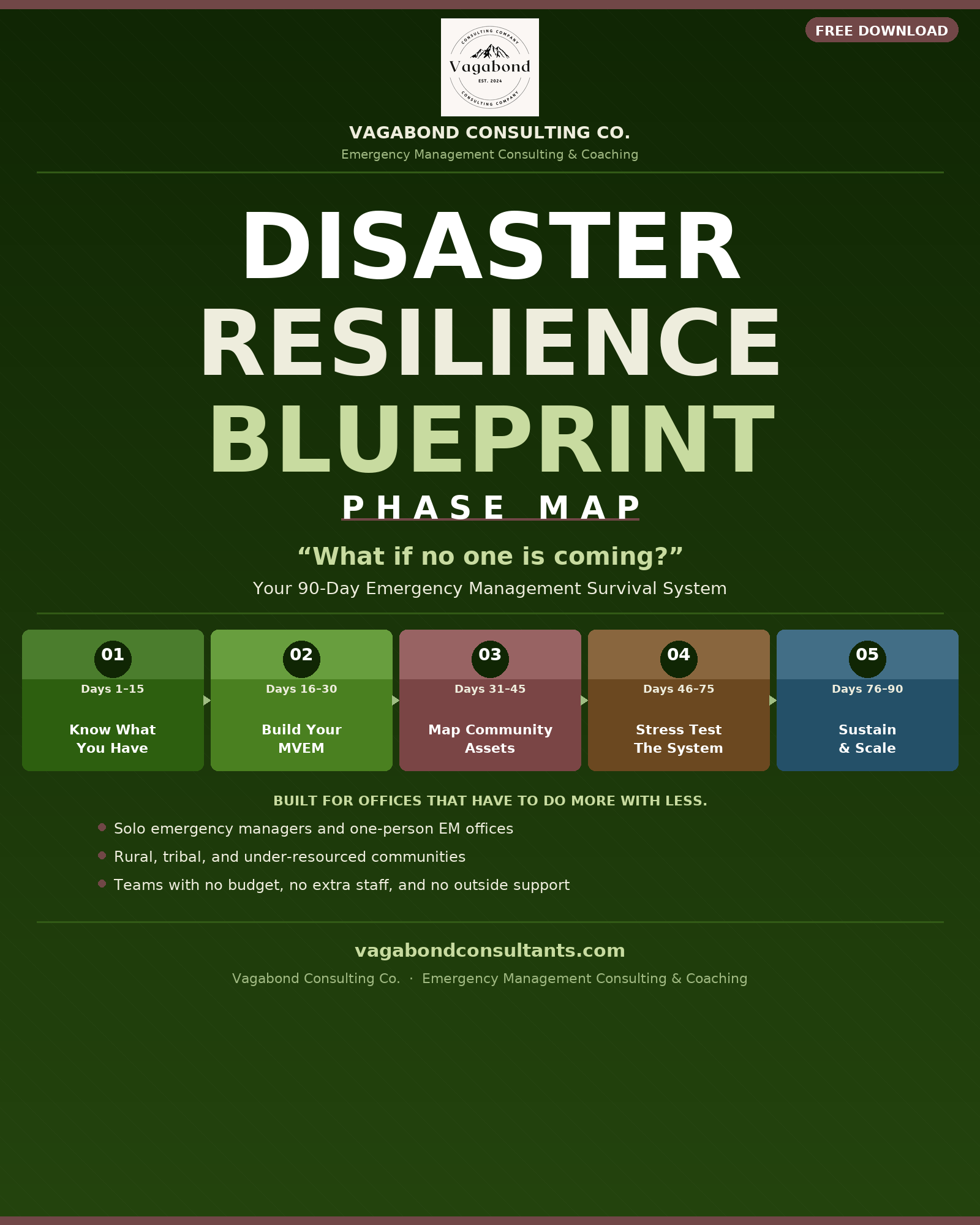
What's Inside: The Playbook walks you through five phases of work over 90 days. Each phase builds on the last. You don't need to complete it all at once — it's designed to fit inside a real workload.
-
Days 1 through 15 Start with an honest baseline. What plans exist and which ones are actually current? Who are your real contacts — the ones who will answer on a Sunday? What hazards are you facing and how prepared are you for each one?
-
Days 16 through 30 Using the Minimum Viable Emergency Management (MVEM) framework, you'll identify your highest-priority functions and build the essential plans, documentation, and resource pathways to support them. This phase is about doing enough of the right things — not everything.
-
Days 31 through 45 The Hidden Capacity Framework. Your community has more resources than a government database will show you. This phase maps what's actually available: government partners, private sector relationships, community organizations, and individual human capital that isn't labeled as an emergency resource.
-
Days 46 through 75 Tabletop exercises, decision matrices, and documentation that will hold up in an actual activation. This phase tests what you've built before a real event forces the test.
-
Days 76 through 90 Building something that outlasts you. Annual calendars, corrective action tracking, a funding pipeline, and a plan for keeping your systems current even when the workload spikes.
Values / Working Principles
How we work together.
Partnership, not prescription. We don't come in with a plan and hand it to you. We build it with you. Your community's context, your constraints, and your knowledge of your own people and hazards are essential to the work.
Plain language. Federal jargon stays in federal documents. Everything we write for your office is in plain, accessible language — because clarity is a form of respect.
Editable, client-owned. You receive every deliverable in editable formats. There are no licensing restrictions. You can modify, share, and use the work however serves your community.
Equity-adjusted pricing. Our fees are based on your community's actual capacity to pay. We don't turn away offices because their budget is small. We find a way.
No dependency. The goal is for you to not need us anymore. Every engagement is designed to leave you better equipped than we found you.