
Meet the Founder

Hello!
Melissa "Issa" (Ee-sa) Boudrye
My career has taken me from a small rural community in Panama as a Peace Corps volunteer to disaster operations across the United States with FEMA and, today, to leading resilience initiatives for the State of California. Through every role, one thing has remained constant: I believe communities are strongest when they have the knowledge, tools, and confidence to lead their own future.
As a Peace Corps Volunteer, I learned that lasting solutions don't come from the top down—they come from listening first and working alongside the people who know their communities best.
Following Hurricane Maria, I joined FEMA's disaster workforce and spent the next several years supporting communities through hurricanes, wildfires, tornadoes, pandemics, and other disasters across the country. From local recovery efforts to national leadership roles—including serving as Operations Section Chief during the 2023 Maui wildfires—I saw firsthand how difficult it can be for small communities to navigate complex emergency management systems.
Today, I help lead California's Resilience Branch at Cal OES, where I work to strengthen local capacity through planning, partnerships, technical assistance, and access to mitigation funding. Across every stage of my career, my passion has remained the same: helping communities build lasting capability—not dependence.
That's why I created the Disaster Resilience Blueprint™.
I believe every community—regardless of size or budget—deserves access to practical tools, clear guidance, and systems they can sustain long after a consultant has left. My goal isn't to become indispensable. It's to help you build an emergency management program that is.
Because resilience isn't built by outside experts. It's built by empowered communities.
Who We Are
Vagabond Co.
Emergency management isn't theoretical.
It is built through experience.
Our founder has led disaster operations at the federal, state, and local levels, supporting some of the nation's most complex disasters and helping communities navigate response, recovery, mitigation, and long-term resilience.
That experience informs every recommendation we make—grounded not in theory, but in lessons learned from real emergencies.
TRUSTED EXPERIENCE
Federal Operations Section Chief
20+ Presidential Disaster Declarations
$1B+Mitigation Portfolio Managed
California Resilience Branch Founder
Federal • State • Tribal • Local
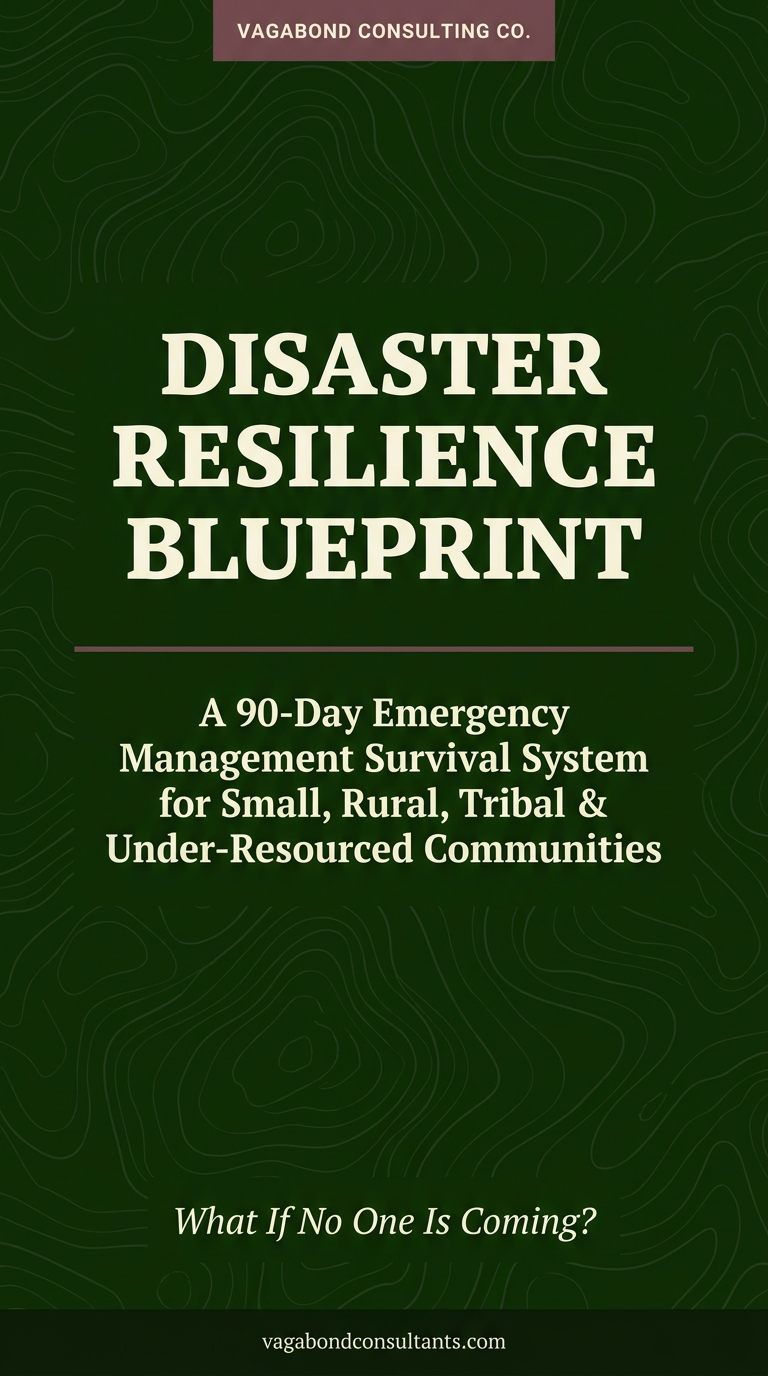
If you're managing emergency preparedness for a small, rural, tribal, or under-resourced community, you already know the reality: limited staff, limited budget, and a federal system that wasn't designed with you in mind. When a disaster hits, outside support isn't guaranteed. You need a system that works even when no one is coming.
The Disaster Resilience Blueprint Playbook is a 26-page PDF guide that walks you through building that system in 90 days. It's structured in five phases — from taking stock of what you already have, to building your core operational framework, mapping the resources hidden in your community, testing your plan under realistic pressure, and putting in place the habits and documentation that keep it running year after year.
This isn't a generic compliance checklist or a federal template repurposed for the wrong audience. Every phase is written for the practitioner doing this work with limited support — the person who needs to move fast, document well, and build something that holds up when it matters most.
The Playbook includes three proprietary frameworks developed specifically for under-resourced offices: a minimum viable approach to emergency management, a method for finding and activating community capacity you didn't know you had, and a documentation system built around FEMA reimbursement requirements. These aren't theoretical — they're practical tools you can start using in the first week.
What's Inside
A 90-day phased roadmap from assessment through sustainability, broken into clear, actionable steps
The Minimum Viable Emergency Management (MVEM) framework — build your core program with what you actually have
The Hidden Capacity Framework — identify and map government, private sector, community, and human capital assets in your jurisdiction
The Documentation Defense System — record your work in a way that supports FEMA reimbursement and program accountability
Five decision matrices to navigate common EM scenarios without second-guessing yourself
A community asset mapping module for a full resource picture of your jurisdiction
An annual calendar framework for sustaining your system after day 90
A funding pipeline overview for identifying and pursuing grants
Who This Is For
Emergency managers running a small or solo EM office with 0–3 staff and limited budget
Community leaders and first responders in rural, tribal, or under-resourced jurisdictions who've taken on EM responsibilities
EM professionals recently hired, promoted, or handed a program that needs to be built from scratch
Anyone who's looked at federal guidance and found it written for a different kind of office