

It's 2:17 a.m.
Your phone won't stop ringing.
The storm is getting worse, your elected officials are asking for answers, and your community is counting on you.
You look around the room... and realize you're the only emergency manager on duty.
What if no one is coming?
We build emergency management systems that hold — even when no one shows up to help.
Every emergency manager hopes someone will answer the phone.
But budgets are shrinking.
Federal resources are changing.
Staffing shortages are growing.
That's why we built the Disaster Resilience Blueprint.

Introducing the Disaster Resilience Blueprint™
Build the Foundation for Community Preparedness in 90 Days
The Disaster Resilience Blueprint is a hands-on implementation program designed specifically for small jurisdictions, Tribal Nations, rural communities, and under-resourced emergency management offices.
By the end of the program, you'll have:
A stronger emergency management program
FEMA and state-ready documentation
Training and exercise guidance
and more…
Most importantly-
You'll know what to do before the next disaster arrives.
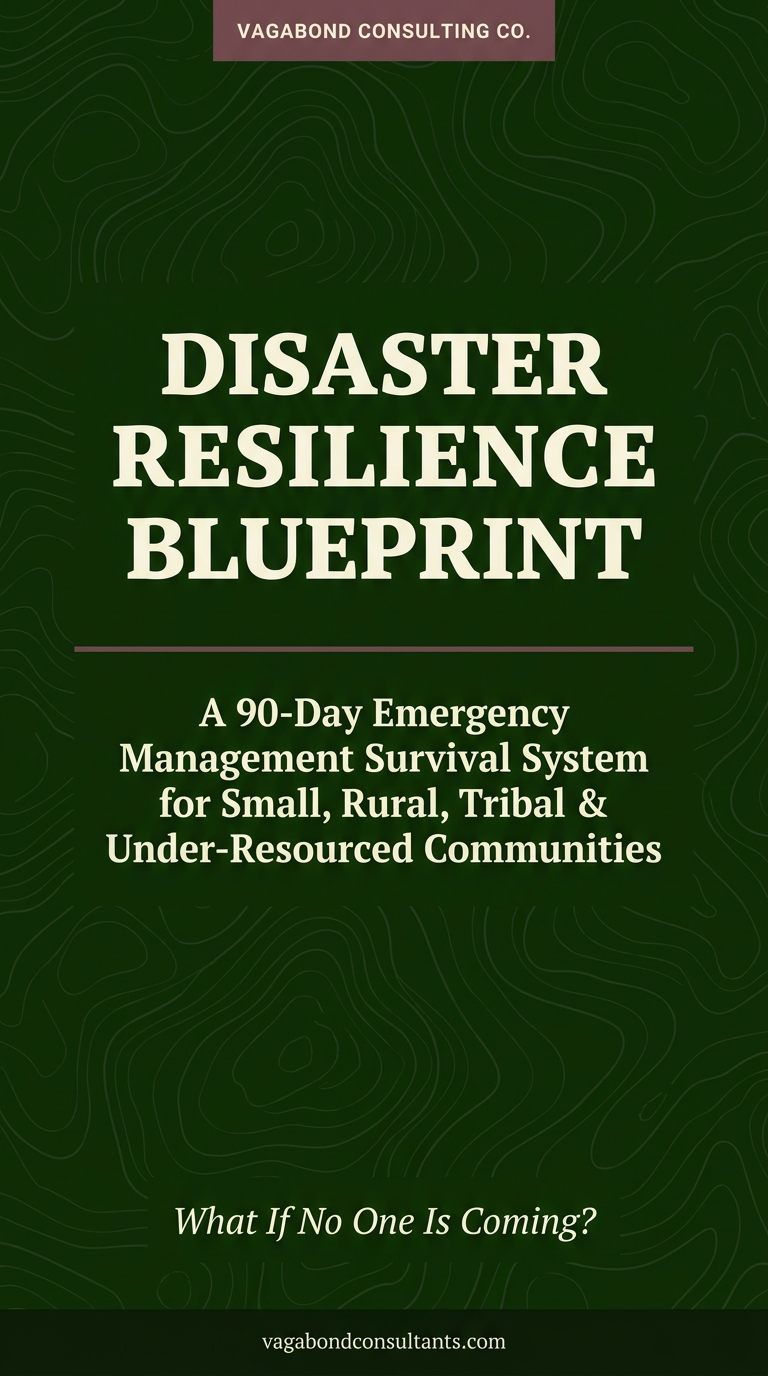
If you're managing emergency preparedness for a small, rural, tribal, or under-resourced community, you already know the reality: limited staff, limited budget, and a federal system that wasn't designed with you in mind. When a disaster hits, outside support isn't guaranteed. You need a system that works even when no one is coming.
The Disaster Resilience Blueprint Playbook is a 26-page PDF guide that walks you through building that system in 90 days. It's structured in five phases — from taking stock of what you already have, to building your core operational framework, mapping the resources hidden in your community, testing your plan under realistic pressure, and putting in place the habits and documentation that keep it running year after year.
This isn't a generic compliance checklist or a federal template repurposed for the wrong audience. Every phase is written for the practitioner doing this work with limited support — the person who needs to move fast, document well, and build something that holds up when it matters most.
The Playbook includes three proprietary frameworks developed specifically for under-resourced offices: a minimum viable approach to emergency management, a method for finding and activating community capacity you didn't know you had, and a documentation system built around FEMA reimbursement requirements. These aren't theoretical — they're practical tools you can start using in the first week.
What's Inside
A 90-day phased roadmap from assessment through sustainability, broken into clear, actionable steps
The Minimum Viable Emergency Management (MVEM) framework — build your core program with what you actually have
The Hidden Capacity Framework — identify and map government, private sector, community, and human capital assets in your jurisdiction
The Documentation Defense System — record your work in a way that supports FEMA reimbursement and program accountability
Five decision matrices to navigate common EM scenarios without second-guessing yourself
A community asset mapping module for a full resource picture of your jurisdiction
An annual calendar framework for sustaining your system after day 90
A funding pipeline overview for identifying and pursuing grants
Who This Is For
Emergency managers running a small or solo EM office with 0–3 staff and limited budget
Community leaders and first responders in rural, tribal, or under-resourced jurisdictions who've taken on EM responsibilities
EM professionals recently hired, promoted, or handed a program that needs to be built from scratch
Anyone who's looked at federal guidance and found it written for a different kind of office
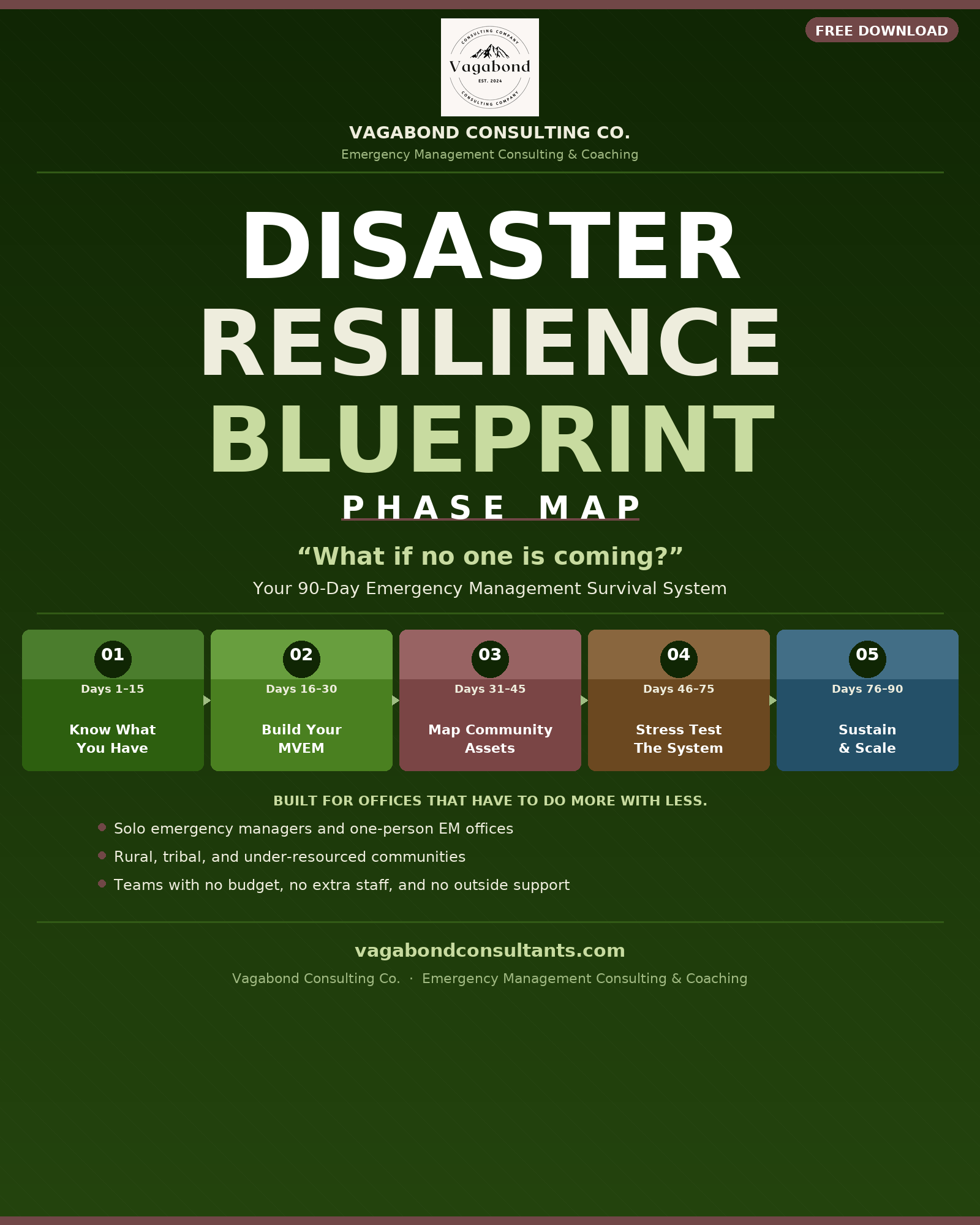
Your 90-Day Roadmap for Building an Emergency Management System From Scratch
Official Phase Titles:
Phase 1: Know What You Have (Days 1–15)
Phase 2: Build Your MVEM (Days 16–30)
Phase 3: Map Your Community Assets (Days 31–45)
Phase 4: Stress Test The System (Days 46–75)
Phase 5: Sustain & Scale (Days 76–90)
The Disaster Resilience Blueprint Phase Map breaks down the full 90-day system into five clear, sequential phases — so you always know where you are, what comes next, and what you're building toward.
Designed for solo emergency managers and under-resourced offices with limited staff, no outside support, and no time to waste. No jargon. No fluff. Just a practical roadmap built around the question every small EM office needs to answer:
What if no one is coming?
Download the Phase Map free — then grab the full Playbook when you're ready to go deeper.

Why Communities Choose Vagabond Co.
We don't believe preparedness should be complicated.
Our approach is practical, collaborative, and implementation focused.
We help communities:
Build sustainable systems instead of one-time plans.
Increase capacity without increasing staff.
Strengthen preparedness through practical tools and processes.
Improve coordination across departments and partners.
Because resilience isn't built during disaster.
It's built long before it begins.